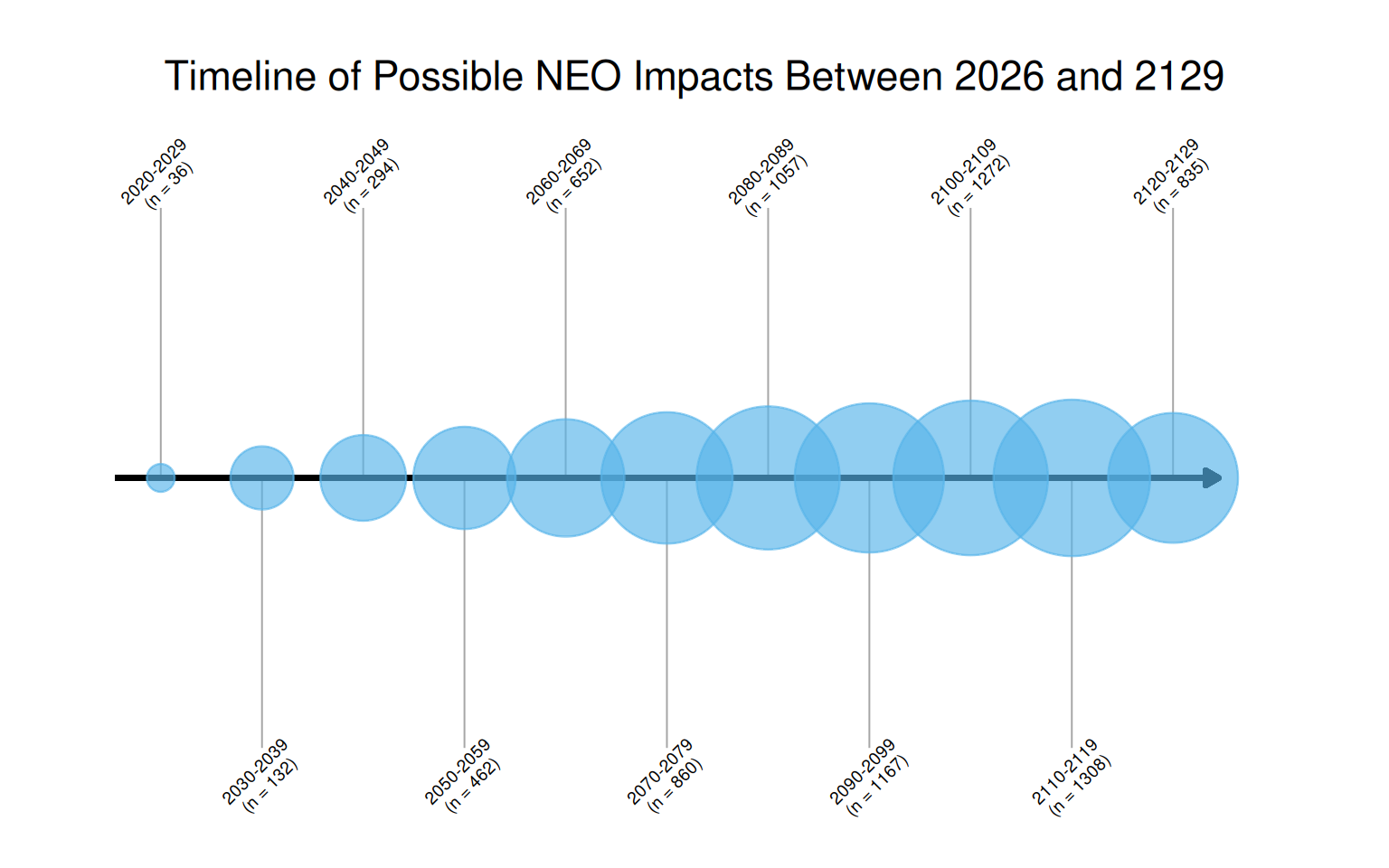
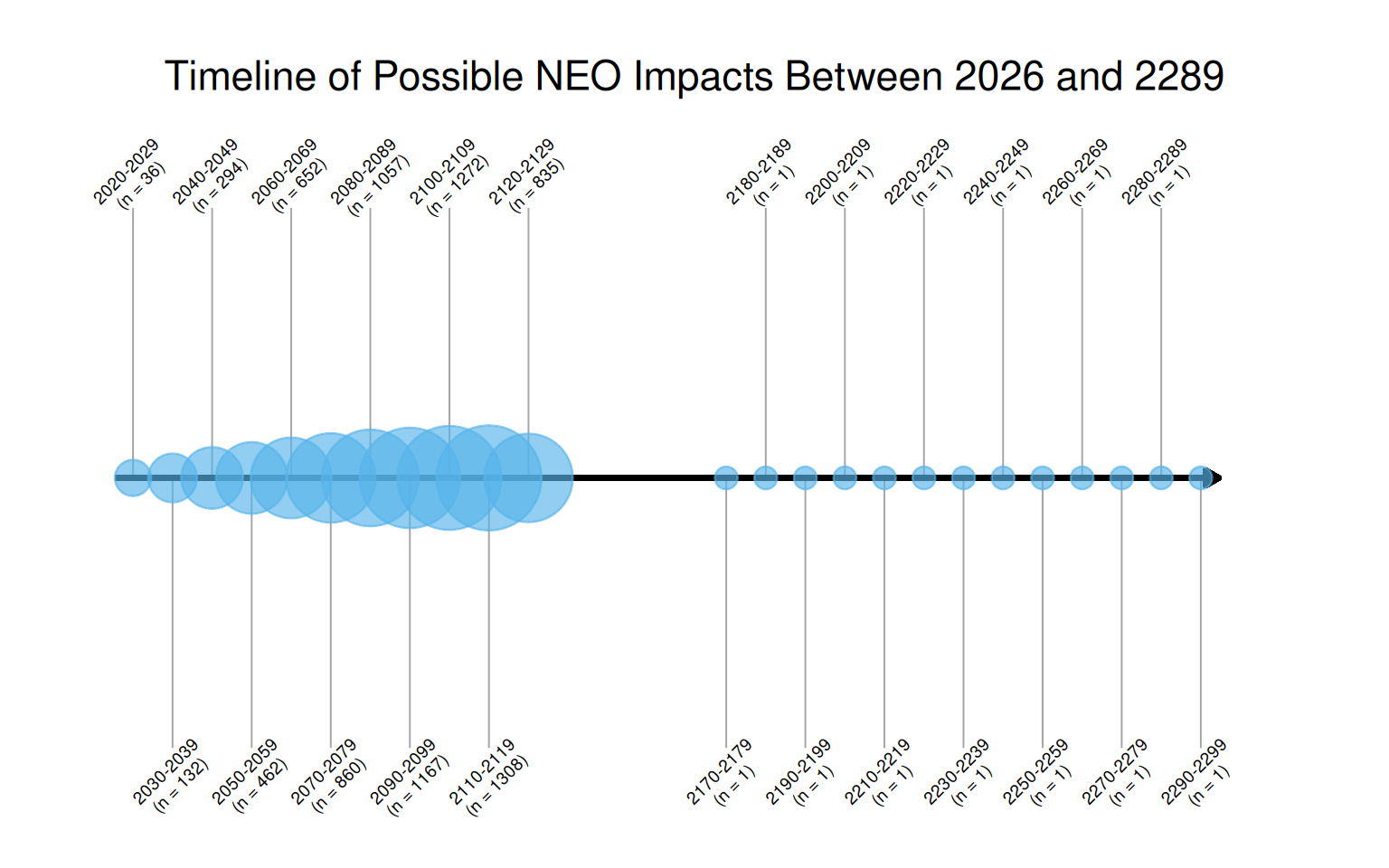
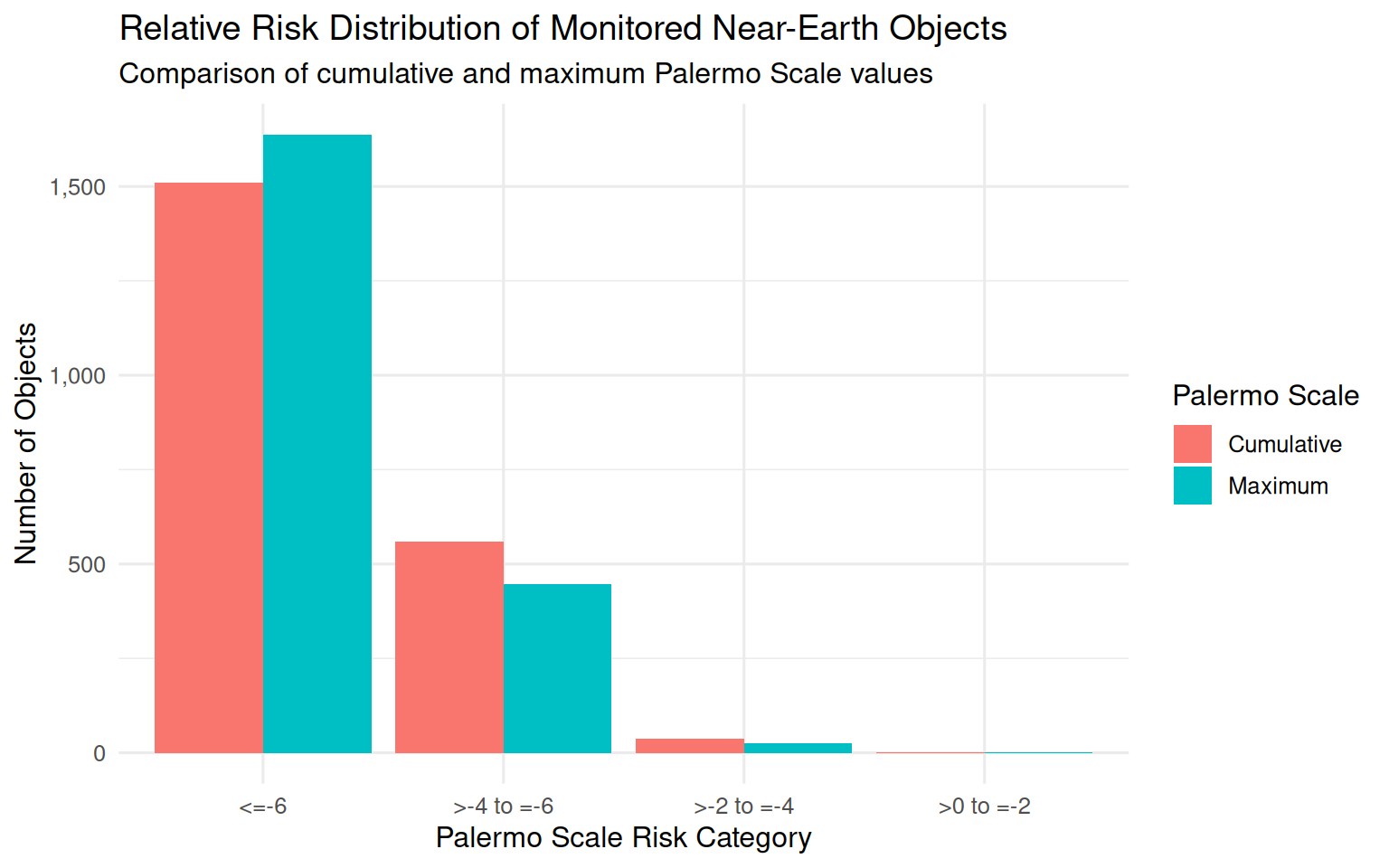
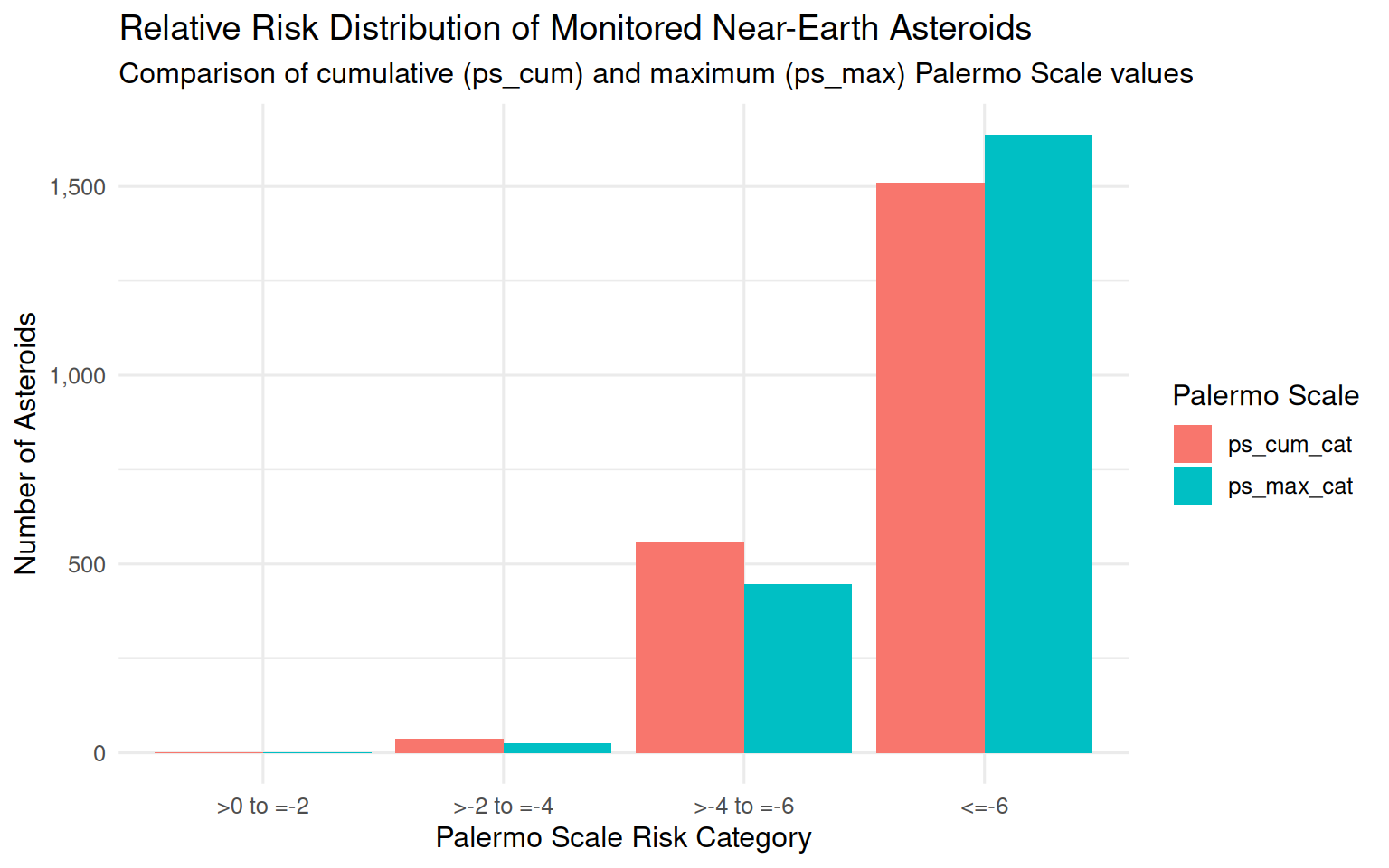
At any given moment, experts in space science are tracking over 2,000 near-Earth objects (NEOs) that could pose a potential risk to life on Earth due to their orbital trajectories, estimated diameters, and projected velocities. NASA’s JPL Sentry System is an Earth impact monitoring system designed for comprehensive observation and collection of data regarding these objects. But how do people not intimately familiar with space science concepts engage with this information? This project seeks to make data regarding possible impact events more approachable to the everyday person, presenting different elements of Sentry’s data in ways that better contextualize the actual risk of currently monitored NEOs, the range in which potential impacts might occur, and the scale of risk currently associated with said objects.
Each row in NASA’s sentry table represents a near-Earth Object (NEO) currently monitored by Sentry that presents any statistical chance of impacting the Earth. To illustrate what each column and data point represents, we will use the asteroid 2024 YR4 as an example, which briefly had a 3.1% chance of hitting Earth before further calculations reduced that risk to 0.00081%, generating significant media attention as a result.
Year Detected
2nd Half of December
117th Designation That Half-Month
Recorded Jan 2025
Revised Mar 2026
Provisional designation: Year + half-month code + sequence subscript
Most recent observation date
Best guess based on shape and light reflection intensity
Years in which impact could occur
Possible impacts throughout year range
Cumulative chance across all passes
Speed without major gravitational pull
Logarithmic · Technical Audience
| < -2 | -2 | -1 | 0 | > 0 |
| < -2 | Less than 1% of background risk | Minimal concern |
| -2 to -1 | 1-10% of background risk | Worth monitoring |
| -1 to 0 | 10-100% of background risk | Careful attention |
| 0 | Equal to background risk | Serious attention |
| > 0 | Exceeds all background risk | High priority |
Reported as Cumulative (all passes) and Maximum (worst single pass). Nothing currently exceeds -2.
Integer 0-10 · Public Communication · Impacts < 100 Years Away
| 0 | 1 | 2 | 3 | 4 | 5 | 6 | 7 | 8 | 9 | 10 |
| 0 | No Hazard | Burns up in atmosphere or no risk |
| 1 | Normal | Routine pass, no discernible danger |
| 2-4 | Attention | Warrants monitoring by astronomers |
| 5-7 | Threatening | Potentially unprecedented global threat |
| 8-10 | Certain | Collision certain; size determines severity |
No known object currently exceeds a Torino score of 1.